I think I first ran into NAD+ around the time I was reading Peter Attia's Outlive, and by the time I got to the very first Livelong Summit in West Palm Beach in March 2024, it was a hot topic. Everyone seemed to be talking about it, the mouse studies sounded amazing, and I was curious. So that spring, I started taking oral NMN and stuck with it for a while.
And honestly? I didn't feel any different. I also realized I didn't really know what it was supposed to be doing for me. So I stopped.
I hadn't thought about it much since. But lately I keep hearing about IV NAD drips, and so many of you have been asking me about NAD in comments and messages. So I went back to the research and asked myself a simple question: is the science really there yet?
Here's what I found, as plainly as I can put it.
What NAD+ actually does
NAD+ (nicotinamide adenine dinucleotide) is a helper molecule in every cell of your body. It isn't exotic, and you can't live without it. A few of its jobs:
- Energy production. In your mitochondria, the small power plants inside your cells, NAD+ carries electrons so your body can turn food into usable energy.
- DNA repair. Enzymes called PARPs use NAD+ to help fix everyday wear and tear on your DNA.
- Sirtuins. A family of proteins involved in metabolism and stress responses that need NAD+ to work. They're part of why NAD+ got so much attention in aging research.
NAD+ levels in some tissues drop as we get older. Part of the reason seems to be low-grade inflammation, along with an enzyme called CD38 that breaks NAD+ down and becomes more active with age.¹ ²
So the biology is real and genuinely interesting. The question is whether taking something to raise NAD+ actually makes a difference for us.
Why so many people are taking it
The story usually goes like this. In mice, raising NAD+ improved some signs of aging in a number of studies.² That's a big, exciting finding, and it's also a big leap from a mouse to any 45-year-old woman juggling work, family, and her own sleep.
From there, marketing took over. Supplement brands, longevity podcasts, and now IV clinics have made NAD+ sound like a fountain of youth. Some of the people selling it are thoughtful. Some are mostly selling.
What people are taking it for
The number one reason is "anti-aging": more energy, less brain fog, better recovery, and that hard-to-define feeling of aging better. Here's what the evidence says for each of the things people hope it will do.
- Energy and fatigue. This is the biggest promise and the weakest result. Across human trials, NR and NMN raise NAD+ levels, but effects on health and function have been mixed and often null.¹⁰
- Brain fog and focus. Mostly anecdotal. The few controlled trials on thinking and memory have been in people with cognitive impairment, not healthy adults, and haven't shown a clear benefit.²²
- Blood sugar and insulin. The best-known positive result was a small study of 25 postmenopausal women with prediabetes. NMN improved how well their muscles responded to insulin, but their blood sugar didn't change.⁸ In men with obesity, high-dose NR didn't improve insulin sensitivity at all.⁶
- Blood pressure. In the 2018 NR trial in healthy middle-aged and older adults, blood pressure trended a little lower, but the change wasn't statistically significant. The researchers called it something to study further, not a finding.⁵
- Exercise and recovery. There are small, mixed studies in older adults. In one, NMN changed some measures of muscle function in older men while most others didn't move.¹⁷ In another, NMN slightly improved a six-minute walk test in middle-aged adults.⁹ Neither shows a clear recovery benefit you'd notice.
- Sleep, mood, skin, and fertility. A couple of small studies in older adults reported modest changes in sleep quality or drowsiness with NMN, but they're small and short.²⁰ ²¹ For mood, skin and fertility, most of the support comes from marketing or mouse studies, not human trials.
- IV clinic uses. Some IV clinics also advertise NAD+ drips for hangovers, addiction withdrawal, long COVID and pain. I couldn't find controlled trials showing IV NAD+ helps any of these.
- Disease research. This is where the real science is happening, in small, early studies in people with specific conditions, done under medical care. They include Parkinson's disease,³ heart failure,⁴ and ALS (where an NR-containing combination was tested in a 32-person pilot sponsored by a supplement company).¹⁸ These studies are worth watching. But they're not the same as a wellness drip or a daily pill for a healthy person.
What the human studies show for NR and NMN
NR (nicotinamide riboside) and NMN (nicotinamide mononucleotide) are the two pill forms. Your body converts them into NAD+.
Here's the honest summary. They reliably raise NAD+ levels in the blood, and they look safe in the short term. But a higher number hasn't reliably translated into people feeling or functioning better.
- In healthy middle-aged and older adults, six weeks of NR raised blood NAD+ and was well tolerated.⁵
- In men with obesity, 12 weeks of high-dose NR didn't improve insulin sensitivity or body composition.⁶
- In older men, NR changed some muscle chemistry and inflammation markers, but didn't improve how their mitochondria worked.⁷
- In a small study of postmenopausal women with prediabetes, NMN improved how well muscle responded to insulin. But blood sugar, blood pressure, body fat and liver fat didn't change.⁸
- In healthy middle-aged adults, NMN raised NAD+ and slightly improved a walking test, while a "biological age" measure didn't change significantly. That study was industry-funded.⁹
A 2026 review of 33 human studies came to the same conclusion. NR and NMN clearly hit their target, but the effects on real health outcomes were mixed and "often null."¹⁰
What "raising the blood number" actually means
When a study says NR or NMN "raised NAD+," it means NAD+ went up in a blood sample. Sometimes the increase is big: in one trial, NR raised NAD+ in blood immune cells by about 60% compared with placebo.⁵ Other trials have found clear rises in whole blood, too.⁹ ¹⁷
But there's no established clinical "normal" or target range for NAD+. It isn't a standard test your doctor orders, and labs measure it in different ways (whole blood, plasma, red cells, or immune cells), so results from different tests often can't be compared.²³ One large 2026 study even found that whole-blood NAD+ stayed about the same with age and with lifestyle changes, which raises questions about using it as a marker of aging at all.²⁴
Home test companies fill that gap by setting their own "optimal" ranges. Those are each company's own definitions, not medical standards.
So a higher number tells you the supplement was absorbed and did what it chemically should. It doesn't tell you that you're healthier, more energetic, or aging more slowly. That part still hasn't been shown. Looking back, that matches my own experience pretty well: nothing I could feel.
What about IV drips?
This is the question I get most now. The short answer is that the evidence is thinner here than it is for the pills.
- There are no outcome trials of IV NAD+ for wellness or anti-aging in healthy people. The 2026 review didn't find a single one, only one small study tracking where the infused NAD+ goes in the body.¹⁰ ¹¹
- Side effects are common during the drip. In a review of records from one IV clinic chain, people getting NAD+ reported moderate to severe stomach upset, a faster heartbeat, and chest pressure during infusions, so the drips often had to be slowed down. The symptoms went away when the infusion ended. That study was run by the clinic company itself.¹² (In the small 2019 pilot, a very slow 6-hour infusion caused no reported side effects.¹¹)
- Drips can also cost hundreds of dollars a session, involve a needle, and quality varies from clinic to clinic.
What a longevity doctor says
Peter Attia, the physician behind Outlive and The Drive podcast, is about as deep into longevity science as anyone. He's been consistently skeptical about NAD.
In a 2024 episode of his podcast, he sorted popular longevity ideas into categories from "proven" to "nonsense." About NAD, he said that "at this moment" he was putting it "in a category even below fuzzy," adding, "to be clear, I'm not putting it in the nonsense category."¹³ He left room for possible uses in specific diseases, but not for slowing aging in healthy people.
Later that year, on the Huberman Lab podcast, he called the NR-versus-NMN question "just a commercial issue," pointed out that NR didn't extend lifespan in the NIH-funded mouse testing program, and said he doesn't take either one.¹⁴
Where NMN stands with the FDA
In 2022, the FDA said NMN couldn't be sold as a dietary supplement because it was being studied as a drug. In September 2025, the agency reversed that decision. NMN can be sold as a supplement again, but companies still have to meet the usual requirements for new supplement ingredients.¹⁵
One thing worth knowing: "allowed to be sold" isn't the same as "proven to work." Supplements aren't approved by the FDA for effectiveness. And no IV or injectable NAD+ product is FDA-approved for anti-aging or wellness.
Questions to ask your doctor
If you're curious, these are good questions to bring to your next appointment:
- Is there any reason NAD+ precursors wouldn't be a good fit for me, given my health history and medications?
- I'm pregnant, breastfeeding, or have a history of cancer. Should I avoid these?
- Is an IV drip safe for me, especially with my heart health?
- What would we expect to change, and how would we know if it's working?
- Is there something simpler we should look at first, like sleep, iron, thyroid, or stress?
Habits that support the same pathways
The encouraging part is that a lot of what NAD+ supplements promise, everyday habits already do, with far more evidence behind them.
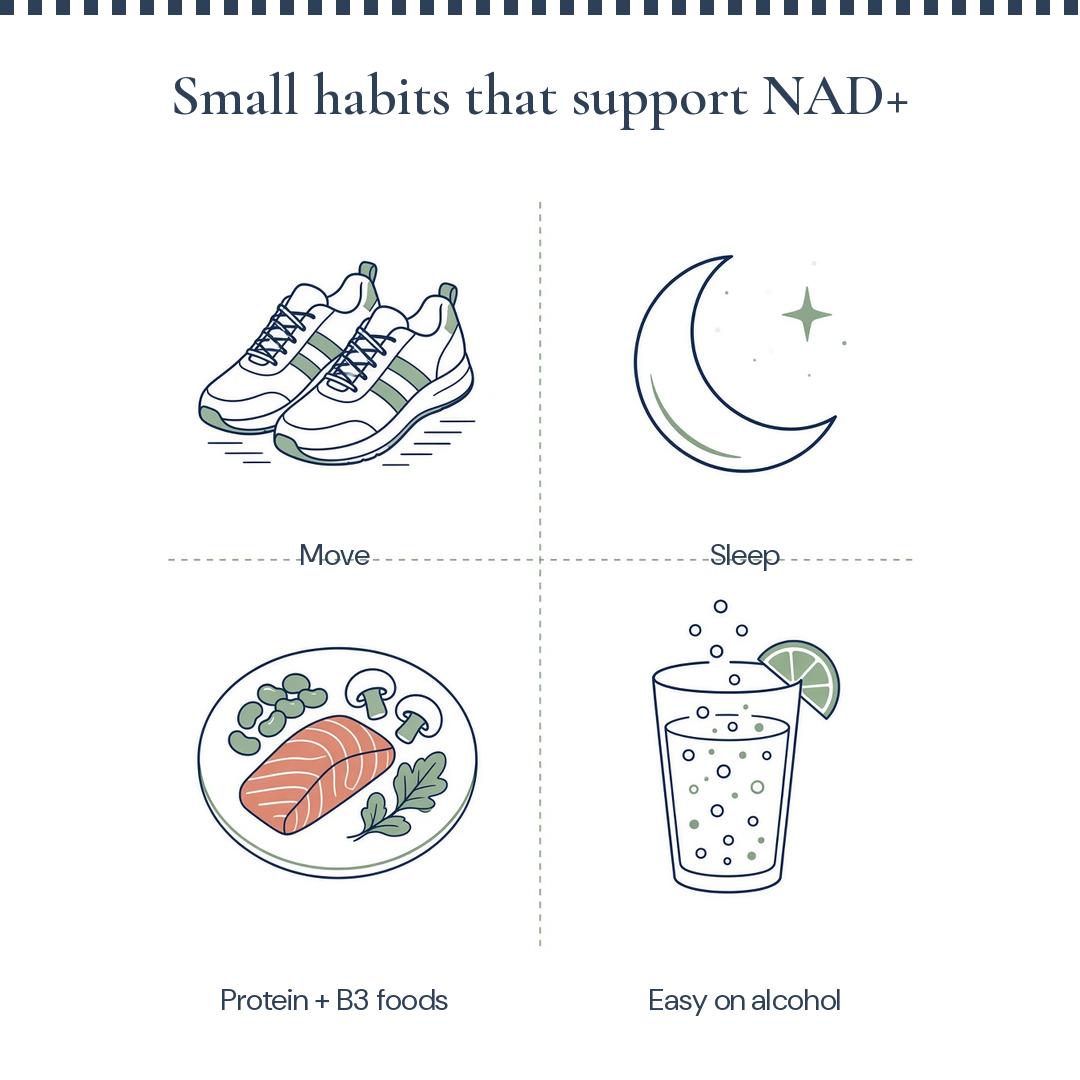
- Move your body. Exercise raises the main enzyme your muscles use to recycle NAD+.¹⁶ Walking, strength training, and anything you'll actually keep doing all count.
- Protect your sleep. In lab research, NAD+ follows the body's daily clock, and good sleep helps nearly everything I write about here.
- Eat enough protein and B3 foods. Poultry, fish, peanuts, beans and lentils, whole grains, and mushrooms all give your body the raw materials to make NAD+.
- Go easy on alcohol. Your body uses NAD+ to process alcohol, so less alcohol leaves more available for everything else.
None of these will go viral. But all of them help in a dozen other ways, too.
Where I've landed
I'm not anti-NAD. The biology is fascinating, and I'll keep watching the research, especially the disease-specific studies.
But right now, the evidence says NR and NMN raise a number in your blood without reliably changing how you feel or how you age. IV drips have even less behind them, and they come with real side effects and real cost. If you're curious, talk it through with your clinician first and keep your expectations modest.
To be fair, no one has tested everyday habits against NAD+ supplements head to head. But movement, sleep, and real food have decades of research showing they help people live longer and feel better. Exercise even works on the same pathway: in older adults, 12 weeks of aerobic or strength training raised the main enzyme muscles use to recycle NAD+.¹⁹
The habits have the proof. The pills have the promise.
For me, the time and money go to the less exciting things that we know work: moving, sleeping, eating enough protein, and being kind to myself along the way.
Sources
- Camacho-Pereira J, et al. CD38 dictates age-related NAD decline and mitochondrial dysfunction through an SIRT3-dependent mechanism. Cell Metab. 2016. https://pubmed.ncbi.nlm.nih.gov/27304511/
- Covarrubias AJ, et al. NAD+ metabolism and its roles in cellular processes during ageing. Nat Rev Mol Cell Biol. 2021. https://pubmed.ncbi.nlm.nih.gov/33353981/
- Brakedal B, et al. The NADPARK study: a randomized phase I trial of nicotinamide riboside supplementation in Parkinson's disease. Cell Metab. 2022. https://pubmed.ncbi.nlm.nih.gov/35235774/
- Yu X, et al. Effect of nicotinamide adenine dinucleotide on heart failure caused by ischemic cardiomyopathy: a randomized, placebo-controlled trial. Am J Cardiovasc Drugs. 2026. https://pubmed.ncbi.nlm.nih.gov/40954388/
- Martens CR, et al. Chronic nicotinamide riboside supplementation is well-tolerated and elevates NAD+ in healthy middle-aged and older adults. Nat Commun. 2018. https://pubmed.ncbi.nlm.nih.gov/29599478/ (full text: https://pmc.ncbi.nlm.nih.gov/articles/PMC5876407/)
- Dollerup OL, et al. A randomized placebo-controlled clinical trial of nicotinamide riboside in obese men: safety, insulin-sensitivity, and lipid-mobilizing effects. Am J Clin Nutr. 2018. https://pubmed.ncbi.nlm.nih.gov/29992272/
- Elhassan YS, et al. Nicotinamide riboside augments the aged human skeletal muscle NAD+ metabolome and induces transcriptomic and anti-inflammatory signatures. Cell Rep. 2019. https://pubmed.ncbi.nlm.nih.gov/31412242/
- Yoshino M, et al. Nicotinamide mononucleotide increases muscle insulin sensitivity in prediabetic women. Science. 2021. https://pubmed.ncbi.nlm.nih.gov/33888596/
- Yi L, et al. The efficacy and safety of β-nicotinamide mononucleotide (NMN) supplementation in healthy middle-aged adults: a randomized, multicenter, double-blind, placebo-controlled, parallel-group, dose-dependent clinical trial. GeroScience. 2023. https://pubmed.ncbi.nlm.nih.gov/36482258/
- Gallagher C, Emmanuel OO. NAD+ supplementation for anti-aging and wellness: a PRISMA-guided systematic review of preclinical and clinical evidence. Ageing Res Rev. 2026. https://pubmed.ncbi.nlm.nih.gov/41655607/
- Grant R, et al. A pilot study investigating changes in the human plasma and urine NAD+ metabolome during a 6 hour intravenous infusion of NAD. Front Aging Neurosci. 2019. https://pubmed.ncbi.nlm.nih.gov/31572171/ (full text: https://pmc.ncbi.nlm.nih.gov/articles/PMC6751327/)
- Reyna K, et al. Intravenous infusion of nicotinamide adenine dinucleotide (NAD+) versus nicotinamide riboside (NR): a retrospective tolerability pilot study in a real-world setting. Front Aging. 2026. https://pubmed.ncbi.nlm.nih.gov/41704678/
- Attia P. #300 – Special episode: Peter on exercise, fasting, nutrition, stem cells, geroprotective drugs, and more — promising interventions or just noise? The Drive. May 6, 2024. https://peterattiamd.com/ep-300-exercise-nutrition-fasting-more/
- Huberman A, Attia P. Dr. Peter Attia: Supplements for Longevity & Their Efficacy. Huberman Lab. 2024. https://www.hubermanlab.com/episode/dr-peter-attia-supplements-for-longevity-their-efficacy
- U.S. Food and Drug Administration. Response to citizen petition on the regulatory status of β-nicotinamide mononucleotide (NMN), Docket FDA-2023-P-0872. 2025. https://www.regulations.gov/docket/FDA-2023-P-0872 (letter copy: https://www.ahpa.org/Files/PDFs/AHPAUpdate/25_0930%20NPA%20NMN%20FDA%20CP%20Response.pdf)
- Costford SR, et al. Skeletal muscle NAMPT is induced by exercise in humans. Am J Physiol Endocrinol Metab. 2010. https://pubmed.ncbi.nlm.nih.gov/19887595/
- Igarashi M, et al. Chronic nicotinamide mononucleotide supplementation elevates blood nicotinamide adenine dinucleotide levels and alters muscle function in healthy older men. NPJ Aging. 2022. https://pubmed.ncbi.nlm.nih.gov/35927255/
- de la Rubia JE, et al. Efficacy and tolerability of EH301 for amyotrophic lateral sclerosis: a randomized, double-blind, placebo-controlled human pilot study. Amyotroph Lateral Scler Frontotemporal Degener. 2019. https://pubmed.ncbi.nlm.nih.gov/30668199/
- de Guia RM, et al. Aerobic and resistance exercise training reverses age-dependent decline in NAD+ salvage capacity in human skeletal muscle. Physiol Rep. 2019. https://pubmed.ncbi.nlm.nih.gov/31207144/
- Kim M, et al. Effect of 12-week intake of nicotinamide mononucleotide on sleep quality, fatigue, and physical performance in older Japanese adults: a randomized, double-blind placebo-controlled study. Nutrients. 2022. https://pubmed.ncbi.nlm.nih.gov/35215405/
- Morifuji M, et al. Ingestion of β-nicotinamide mononucleotide increased blood NAD levels, maintained walking speed, and improved sleep quality in older adults in a double-blind randomized, placebo-controlled study. GeroScience. 2024. https://pubmed.ncbi.nlm.nih.gov/38789831/
- Orr ME, et al. A randomized placebo-controlled trial of nicotinamide riboside in older adults with mild cognitive impairment. GeroScience. 2024. https://pubmed.ncbi.nlm.nih.gov/37994989/
- Freeberg KA, et al. Dietary supplementation with NAD+-boosting compounds in humans: current knowledge and future directions. J Gerontol A Biol Sci Med Sci. 2023. https://pmc.ncbi.nlm.nih.gov/articles/PMC10692436/
- Trętowicz MM, et al. Human whole-blood NAD+ levels do not vary with age or lifestyle interventions. Nat Metab. 2026. https://pubmed.ncbi.nlm.nih.gov/42135539/
Want more like this? Get the free guide.
Annie is a National Board Certified Health & Wellness Coach (NBC-HWC) and Functional Nutrition Alliance Certified Functional Nutrition Counselor (CFNC). This post is for education and coaching support, not medical advice, and it isn't a recommendation to take or avoid any supplement or treatment. Talk with your doctor, pharmacist or other clinician before starting any supplement or IV therapy, especially if you're pregnant or breastfeeding, have a health condition, or take medications.