
Every new year, the big lists come out. Eat better, sleep more, exercise every day, finally get calm. I used to write those lists too. By February most of it had quietly slipped away, and I’d decide the problem was me.
It wasn’t. The problem was the size of the list. Lasting change usually comes from one clear reason, one focus, and one small step you repeat until it’s simply part of your week.
I used to be terrible at goal setting, until I started using some of these techniques. It’s hard, and I won’t pretend it isn’t. But it’s also so rewarding.
This guide walks you through that, over four weeks, with room to write as you go. No resolutions, no starting over on Monday. Just goals that fit your real life, at whatever age and stage you’re in.

This is a goal setting guide with a workbook built right in.
Each week starts with a short reading, so you know what you’re doing and why it helps. The fill-in pages that follow are where you make it yours: your why, your focus, your small step, and the notes you keep as you go.
A four-week walk is enough to get started. After Week 4, the vision board pages and your next small step are there if you want to keep going, at your own pace.
Goals work a lot like the trail on the cover: one path, taken a step at a time, with the view opening up as you go.
How to use this guide
- Give each week its own section. Read it at the start of the week, then use the pages that follow to document your thoughts. Ten or fifteen minutes is plenty.
- Choose one thing. You’ll be tempted to work on everything. Please don’t. One focus is how this works.
- Write it down. A few words count. Your answers are the most useful part of this guide, because they’re yours.
- Expect imperfection. Missed days are part of the plan, not the end of it. Week 3 is all about looking closely at what got in the way.
- After four weeks. When Week 4 is done, use the vision board pages and your next small step to keep going, at your own pace.
How the four weeks work
Week 1 is for planning. You’ll rate a few areas of your life, pick one focus, climb a simple “Why” Ladder built on that area to find the reason underneath your goal, and choose a first small action.
Week 2 is for doing and tracking. You’ll start the habit and keep a simple daily record, plus a few notes on what got in the way.
Week 3 is the deep-dive look. You’ll notice what’s working, what isn’t, and fix the issues that showed up in Week 2.
Week 4 is when the habit is starting to form. You’ll go back to your “Why” Ladder and ask whether what you’re doing is moving you toward your goal. If it isn’t, that’s where the tweaking comes in. If you’re ready, you can also widen your horizon and build a vision board for the year, or write it all down on a one-page plan. You can pull either of these out at any time to keep your goals in sight.
If you have a medical condition, take medication, or are pregnant, please check with your clinician before changing how you eat, sleep or move.
Week 1: Find your why and pick your focus
This week’s focus: Rate a few areas of your life, pick one to focus on, find the reason underneath that choice with a “Why” Ladder, and choose a first small action.
Why it helps: Researchers who study motivation describe two kinds. Extrinsic motivation comes from outside: a number, a deadline, guilt, someone else’s approval. Intrinsic motivation comes from inside: you do something because you enjoy it or because it connects to something you value. When a goal feels like your own choice and fits your values, the research suggests it tends to last longer than one driven by pressure.
Below are a few common areas where people tend to set goals, with room to add one of your own. I like to give each one a quick rating. It helps me see what matters most right now, filter out the noise, and focus on what’s really important.
Here’s what to do: rate how satisfied you feel right now in each area, from 1 (needs a lot of care) to 5 (feeling good). There are no right answers, and a low score isn’t a failing grade. It just shows where a small change could help most. If something that matters to you isn’t on the list, add it under Other.
| Area | Examples | My rating (1-5) | How ready do I feel? |
|---|---|---|---|
| Eat | steadier meals, more plants, protein at your first meal | 1 2 3 4 5 | |
| Sleep | a regular bedtime, a wind-down routine | 1 2 3 4 5 | |
| Move | walking, strength, something playful | 1 2 3 4 5 | |
| Stress | a few minutes a day that are just for you | 1 2 3 4 5 | |
| Connection | time with people who fill you up | 1 2 3 4 5 | |
| Other: (name your own) | something that matters to you that isn’t on this list, like a creative hobby, time outdoors, or learning something new | 1 2 3 4 5 |
Pick one area to focus on. Choose the one that matters most right now, or the one where a small change would help most.
- My focus area:
Once you’ve picked your area, take a few quiet minutes with the questions below. They’ll get you ready for your “Why” Ladder.
Week 1 fill-in: your why
- What do I want to feel like six months from now?
- What have I tried before? What worked, even a little?
- Which goals have I chased mostly because I felt I should?
The “Why” Ladder. Now that you’ve picked an area, use this simple way to find the reason underneath your goal for that area. Most of us start with a surface goal, like “walk more,” “sleep better” or “have more energy in the afternoon.” Those are good goals, but on their own they’re easy to drop when life gets busy. Asking “why” a few times in a row moves you from that surface goal to the value underneath it: something you care about for its own sake, like freedom, energy, peace, or being present for the people you love. That value is what you’ll lean on when willpower runs out.
How to use it:
- Start at the bottom rung with what you want for the area you just chose, in your own words.
- Ask yourself, “Why does that matter to me?” Write your answer on the next rung up.
- Ask, “And why does that matter?” about that answer, and write it on the next rung.
- Keep climbing, about five rungs in all. You’ve reached the top when the answer feels like something you want for its own sake, and asking why again just brings you back to it.
There are no wrong answers, and it’s fine if a rung surprises you. Take your time. This is just for you.
This is my ladder. Yours will look different.
The left side of each rung is the question to ask, and the right side is how I answered it.
Hot yoga, saunas, and cold plunges aren’t for everyone. If it’s something you’d like to try, check with your healthcare provider first.
The ladder is drawn the way you climb it: what you want at the bottom, and your value at the top.

My “Why” Ladder (five rungs). Start at the bottom with what you want, and climb toward the value at the top. The left side of each rung is the question. Write your answers right on the rungs.
- The value at the top of my ladder, in one sentence:
- Where in my life do I already feel that way, even a little?
- How I’ll remind myself of it (a sticky note, a phone screen, a word on the fridge):
Your first small action. A wish like “I want more energy” is a direction, not a step. Make it specific, small and doable next week:
- What exactly will I do?
- When and where?
- How often this week?
- How sure am I, from 1 to 10, that I can do it?
If your confidence is below 7, make the step smaller. “Walk 30 minutes every day” can become “walk 10 minutes after lunch, three days this week.” Small isn’t settling. Small is how you build proof that you can.
Plan with “if… then.” Studies on what researchers call implementation intentions found that people who plan exactly when and where they’ll act (“If it’s 12:30 on a weekday, then I walk around the block”) follow through more often than people who just intend to. Add one backup plan too: “If it’s raining, then I walk the stairs.”
Week 1 fill-in: your first small action
- My big wish:
- What exactly will I do?
- When and where?
- How often this week?
- How sure am I, from 1 to 10, that I can do it?
- My smaller step (if I needed one):
- My main plan: If ________, then I will ________.
- My backup plan: If ________ gets in the way, then I’ll ________.
- Something that might trip me up this week:
- My plan for it: If ________, then I will ________.
- What I can set up ahead to make it easier (shoes by the door, a reminder, a prepped first meal):
Week 2: Start the habit and track it
This week’s focus: Start your small step and keep a simple daily record. Notice what gets in the way. You’ll look more closely at those notes in Week 3.
Track lightly. Keeping track of what you’re doing helps. A large review of studies found that monitoring progress toward a goal made people more likely to reach it, especially when they wrote it down. But tracking only helps if it’s kind. Try:
- A simple check mark on a calendar for each day you did your step
- One word about how it felt (easy, tired, rushed, good)
- No streaks to protect, no “perfect weeks” to chase
I keep a daily habit tracker in my planner. It helps me check off what I consider important and feel accomplished. If a simple daily check appeals to you, yours can be as light as a calendar mark or a one-word note. The 3-week tracker below is here if you’d like a simple, kind place to do the same.
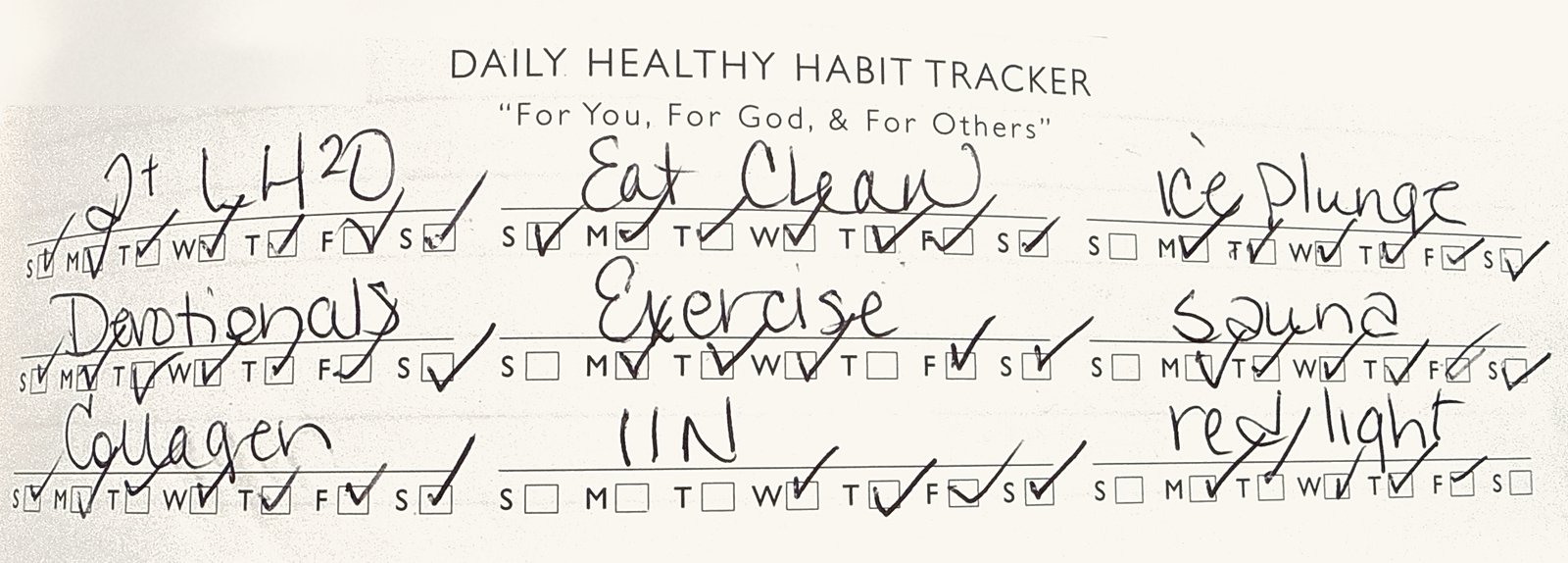
Your 3-week habit tracker
This covers Weeks 2, 3 and 4 of the guide, 21 days in all, since Week 1 is for planning. Write your step at the top. Make a check mark for each day you did it, even the bare-minimum version. Leave missed days blank, no X’s. Add one word in the last column about how the week felt.
- My step:
| Week | Mon | Tue | Wed | Thu | Fri | Sat | Sun | One word |
|---|---|---|---|---|---|---|---|---|
| Week 2 | ||||||||
| Week 3 | ||||||||
| Week 4 |
- How I’ll track (this page, a calendar, a notebook, a phone note):
- What got in the way this week? Missed days are information, not a verdict. Jot a few words when something gets in the way. Next week you’ll use these notes to fix what you can.
Week 3: Look closely and fix what got in the way
This week’s focus: What’s working, what isn’t, and how to fix the issues that showed up in Week 2.
Expect setbacks. Habits take time. In one well-known study, people took a median of about 66 days before a new daily habit stopped getting noticeably more automatic, and the range ran from 18 to 254 days. Missing a single day here and there didn’t meaningfully set people back. So a missed day isn’t failure. It’s information.
When you slip, ask three questions:
- What got in the way?
- Was the step too big, or the timing off?
- What’s the smallest version I can do tomorrow?
Then do that smallest version. What matters most is getting back to it the next day, because doing your step consistently is what builds the habit.
Week 3 fill-in
- What’s working?
- What isn’t working?
- My hardest day of the week usually looks like:
- My “bare minimum” version of my step for that day:
- Something kind I’ll say to myself when I miss a day:
Setback and restart page
Use this page any time you slip. Then do the smallest version the very next day. What matters most is getting back to it the next day, because doing your step consistently is what builds the habit.
- What got in the way?
- Was the step too big, or the timing off?
- What’s the smallest version I can do tomorrow?
- What would I say to a friend in my shoes?
- My restart date:
What I’ll change this week
After a setback, write out the tweak you want to try, in enough detail that you’ll know what to do tomorrow.
- What I’ll change this week:
- The first small thing I’ll do, and when:
- How I’ll know this tweak is helping:
Week 4: The habit is starting to form
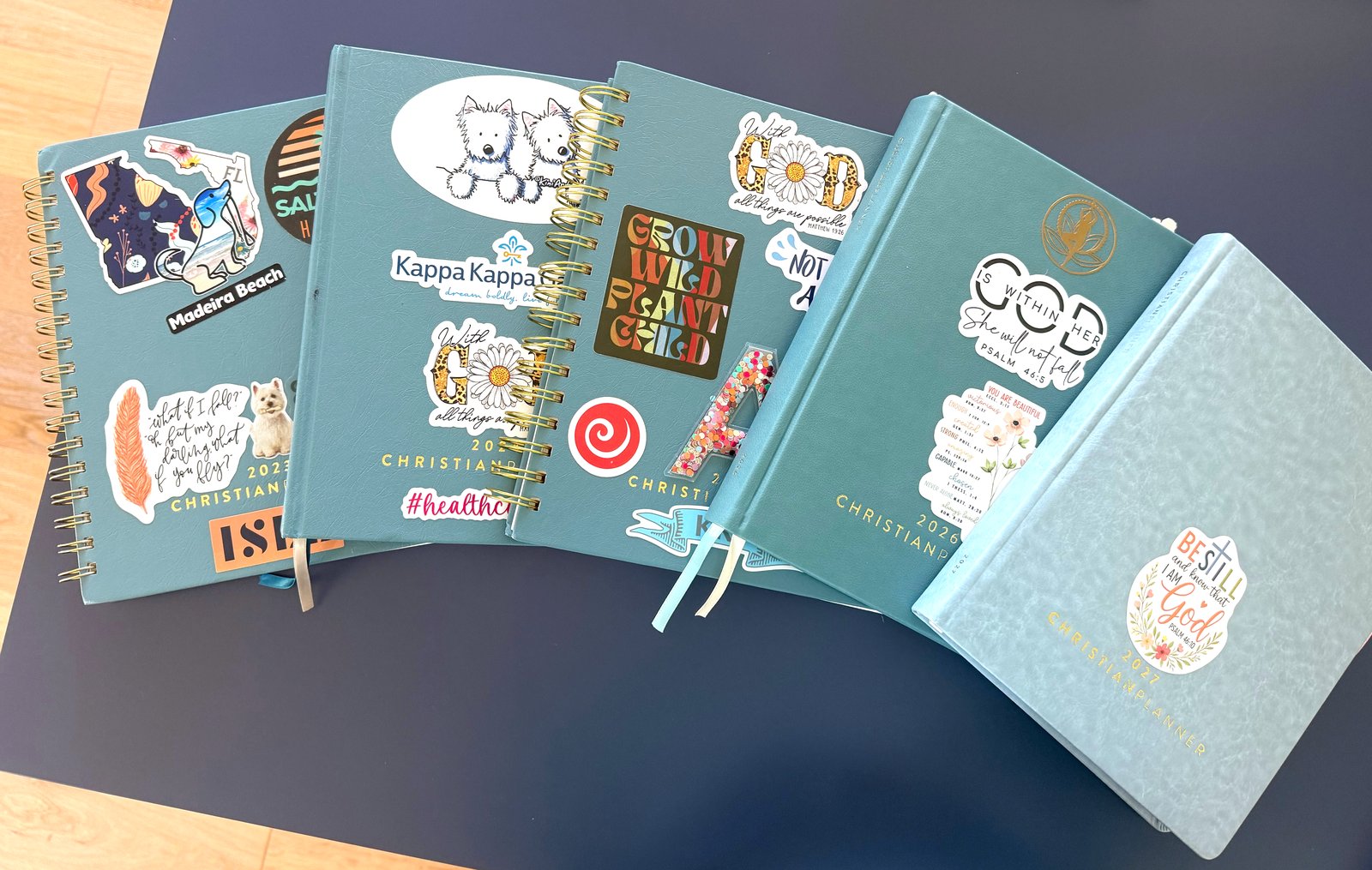
This week’s focus: Your habit is starting to take shape. Go back to your “Why” Ladder and ask whether what you’re doing is moving you toward your goal. If it isn’t, this is where the tweaking comes in.
Revisit your “Why” Ladder. Read the value at the top again. Does it still feel true? Has it shifted? Then look at the step you’ve been practicing: is it actually moving you toward that value, or has it drifted into something that looks good on paper but doesn’t feel like your why? If it isn’t moving you toward the goal, change the step, not the standard you hold yourself to.
Your weekly check-in. Same day, same time, about ten minutes. Ask:
- What went well this week?
- What got in the way?
- Keep it, tweak it, or grow it? (Most weeks, “keep it” is the right answer.)
- What’s my step for next week?
After four weeks. When this week is done, the vision board pages that follow can help you picture the year ahead, and your next small step keeps you moving. Use them at your own pace.
Grow slowly. One new step at a time, only when the last one feels settled. That’s how a single small change turns into a different way of living.
Week 4 fill-in
- Does my value still feel true? Has it shifted?
- Is what I’m doing moving me toward my goal?
- If not, what will I tweak?
- My check-in day and time:
- One thing that’s easier now than four weeks ago:
- Keep, tweak or grow? My plan:
- My next small step:
This may also be the time to widen your horizon on your goals. If you want a picture of the year ahead, the next pages will help you build a vision board that works with your weekly steps, not in place of them. After that, you’ll gather this week’s work onto a one-page plan you can keep in sight.
A simple example from my own life
Here’s how this looks when I do it.
My wish was “feel stronger and more energetic.” When I climbed my “Why” Ladder, the top rung wasn’t about fitness at all. It was the same value that’s on the ladder in Week 1: once I’ve accomplished these, I feel as though I can accomplish anything and move into my Zen place.
I picked move as my focus, and hot yoga was my goal. My small step: I put it in my calendar for the first three weeks of January 2025, two to three times a week. It became a habit. Now I try to go five days a week, and I can’t imagine my daily habits without it. I keep going because I enjoy it. The heat and the community invigorate me, and it helps with my balance and strength. It also sits right on my “Why” Ladder: getting out of bed for hot yoga is one of the rungs that leads me to my Zen place.
Some weeks I make all five days. Some weeks I don’t. When I miss, I don’t start over. I just go back the next day, even if it’s a shorter or gentler class.
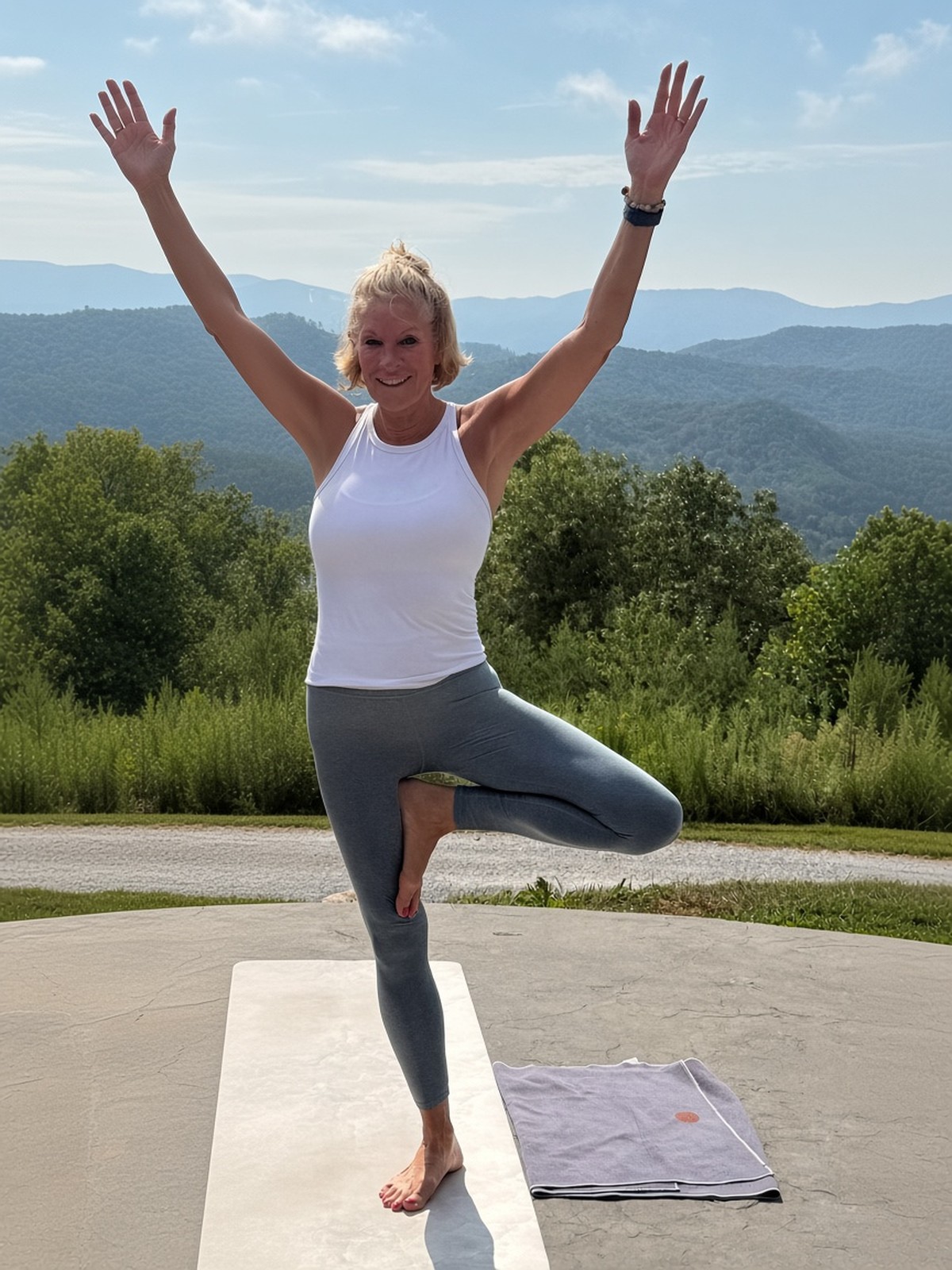
Hot yoga was a challenge for me, but after my first few classes, it was a challenge I wanted to keep improving at.
You might start with a goal that doesn’t actually bring you closer to your why. That’s useful information, not a dead end. Go back to your “Why” Ladder, re-evaluate, and choose something that will.
Build your goals into a vision board for the year

A vision board is a picture of how you want your year to feel. I make one every year.
How to make yours:
- Start with your why. Put the value from the top of your “Why” Ladder at the center or the top of the board. That’s its heart.
- Add your focus area and your small steps. Choose a picture or a few words for each one, like a walking path for “move” or a colorful plate for “eat.”
- Gather pictures and words that show how you want the year to feel. Cut them from magazines, print your own photos, or write words by hand. Pick what makes you feel something, not what you think you should want.
- Put it where you’ll see it every day. A sheet of poster board, a corkboard, a planner page, or your phone’s wallpaper all work. Choose a spot you pass daily, like the fridge, the bathroom mirror, or next to the coffee maker.
Why it helps. For me, seeing my goals every day keeps them front of mind and reminds me of my why. That’s the kind of manifesting I believe in: keeping what you want in sight, so you keep choosing it.
A board can’t do the work for you, though. Research on picturing the future suggests that daydreaming about the result on its own doesn’t help much, and can even leave you with less get-up-and-go. What tends to help more is pairing the picture with a plan: see what you want, be honest about what might get in the way, and know your next small step. So let your board work alongside your weekly steps, not in place of them. When you look at it, ask yourself, “What’s my small step today?”
It’s okay to leave white space on your board. You may start the year not knowing about a passion or a goal that will come up later. Leaving a little room lets you add it when it does, instead of looking at a fully loaded board and feeling overwhelmed.

If cutting and gluing isn’t your thing, that’s fine. A list in your planner or one photo on your phone can do the same job.
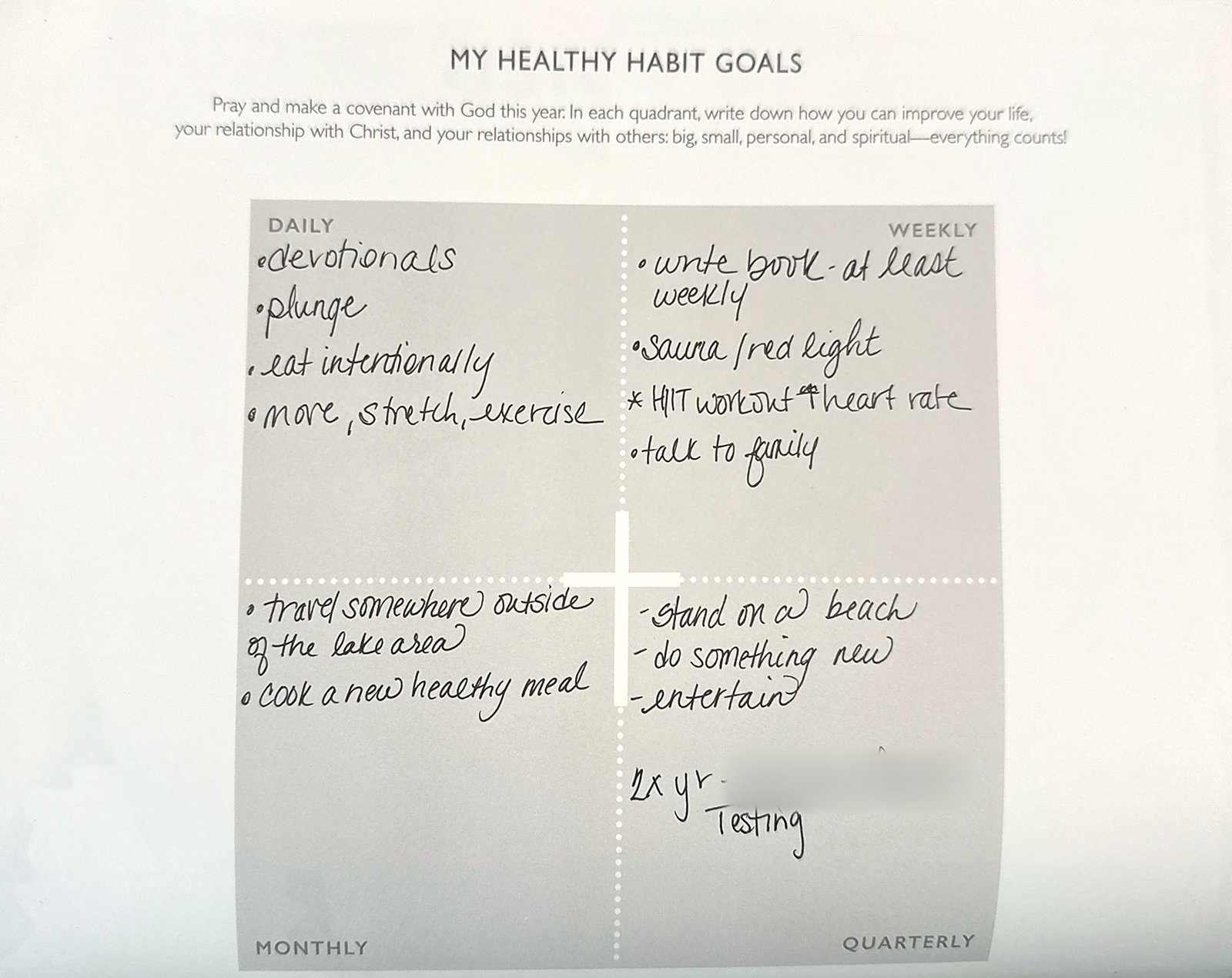
Your year-ahead vision
Picture yourself a year from now, living closer to the value at the top of your ladder. No pressure to get it right. This is a picture, not a contract.
- A year from now, an ordinary good day looks like:
- How I want to feel in my body and mind:
- The people I want to spend more time with:
- Small steps that might get me there, one at a time (Eat, Sleep, Move, Stress, Connection, or your own):
- A word for my year:
- A note to myself to read next year:
Plan your board
- The value at the top of my “Why” Ladder:
- My focus area and my small steps:
- Three words for how I want this year to feel:
- Pictures and words I want to find (photos, magazine pages, my own handwriting):
- Where I’ll put it so I see it every day:
- What might get in the way? If that happens, I will:
- When I look at my board, my small step today is:
Your one-page goal plan
Fill this in once your first small step is clear, and update it whenever your step changes. Keep it where you’ll see it.
Eat / Sleep / Move / Stress / Connection / Other:
Want some support?
A guide can get you started. Sometimes it helps to have someone in your corner who can help you find the right-sized step, notice the patterns, and adjust when life gets busy. That’s what coaching is for. Together, we can build your next small steps around your real life.
Questions? Email me at annie@ardently-annie.life.
Want to go deeper?
There’s more waiting for you at https://ardently-annie.life. Sign up there for the free 7-Day Steady Energy Reset, a one-week guide you get when you join my list: https://ardently-annie.life/#weekly.
You’ll also get my newsletter, which goes out every other Wednesday, with the latest blog post and any new recipe when there is one.
With warmth,
Annie
Sources
- Ryan RM, Deci EL. "Self-determination theory and the facilitation of intrinsic motivation, social development, and well-being." American Psychologist. 2000;55(1):68–78. https://doi.org/10.1037/0003-066X.55.1.68
- Gollwitzer PM, Sheeran P. "Implementation intentions and goal achievement: a meta-analysis of effects and processes." Advances in Experimental Social Psychology. 2006;38:69–119. https://doi.org/10.1016/S0065-2601(06)38002-1
- Harkin B, Webb TL, Chang BPI, Prestwich A, Conner M, Kellar I, Benn Y, Sheeran P. "Does monitoring goal progress promote goal attainment? A meta-analysis of the experimental evidence." Psychological Bulletin. 2016;142(2):198–229. https://doi.org/10.1037/bul0000025
- Lally P, van Jaarsveld CHM, Potts HWW, Wardle J. "How are habits formed: modelling habit formation in the real world." European Journal of Social Psychology. 2010;40(6):998–1009. https://doi.org/10.1002/ejsp.674
- Kappes HB, Oettingen G. "Positive fantasies about idealized futures sap energy." Journal of Experimental Social Psychology. 2011;47(4):719–729. https://doi.org/10.1016/j.jesp.2011.02.003
- Oettingen G, Mayer D. "The motivating function of thinking about the future: expectations versus fantasies." Journal of Personality and Social Psychology. 2002;83(5):1198–1212. https://doi.org/10.1037/0022-3514.83.5.1198
- Wang G, Wang Y, Gai X. "A meta-analysis of the effects of mental contrasting with implementation intentions on goal attainment." Frontiers in Psychology. 2021;12:565202. https://doi.org/10.3389/fpsyg.2021.565202
This guide is for general education and coaching support. It isn’t medical advice, and it doesn’t diagnose, treat, or cure any condition. Health coaching doesn’t replace care from your doctor or a registered dietitian. If you have a medical condition, take medication, are pregnant, or have a history of disordered eating, please talk with your healthcare provider before making changes.
© 2026 Ardently Annie™. Annie is a National Board Certified Health & Wellness Coach (NBC-HWC), IIN Certified Professional Health Coach, and Functional Nutrition Alliance Certified Functional Nutrition Counselor (CFNC). She is not a registered dietitian or licensed nutritionist, and her coaching doesn't diagnose, treat or prescribe.