Search "clean eating" online and you'll find a hundred different answers. Some are helpful. A lot of them are rigid, expensive, or quietly built on fear: cut this, never touch that, buy this special thing.
That's exactly why I rarely tell anyone they need to "eat clean." The term carries so many misconceptions that it can do more harm than good. One person hears "eat more vegetables." Another hears "you've failed if you eat a cracker."
So instead of tossing the phrase around, I want to take the time here to share my version of clean eating, the one I use with clients and in my own kitchen. No purity tests. No "good" and "bad" foods. Just a steadier way to eat that fits a real midlife life, with work, family dinners, and the occasional bag of chips included.
What clean eating actually means (and doesn't)
Let's be honest: "clean eating" isn't a scientific term, and there's no official definition. Here's what I mean when I use it.
When I say clean eating, I mean:
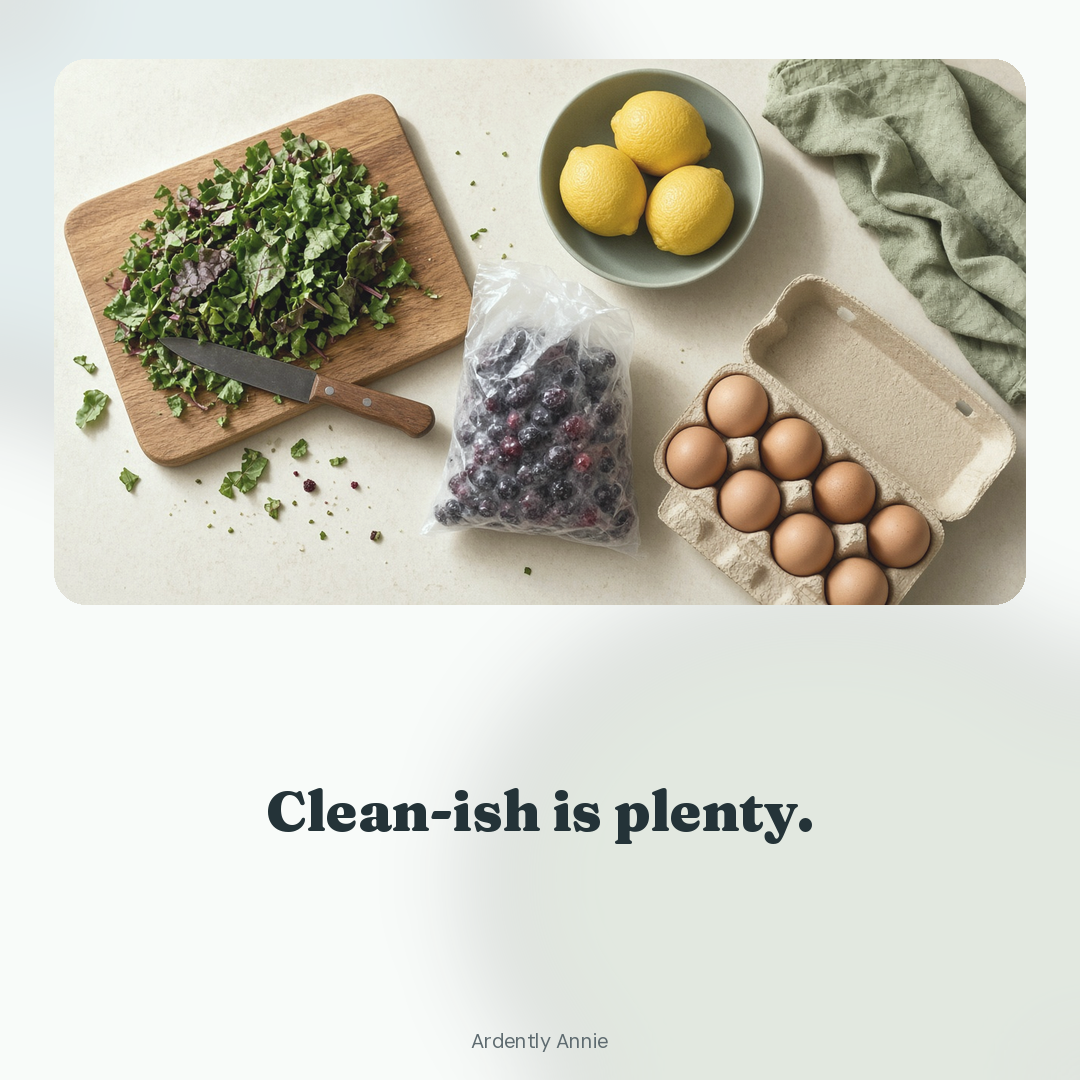
- Mostly whole or minimally processed foods: vegetables, fruit, beans, whole grains, eggs, fish, meat, plain dairy, nuts, and seeds. Frozen and canned versions count too.
- More plants, in whatever form you'll actually eat.
- Protein and fiber at your meals, so you stay full and your energy holds steady.
- Less ultra-processed food, without making it forbidden.
What it doesn't mean:
- Never eating anything from a box or bag
- Labeling foods (or yourself) "good" or "bad"
- Buying everything organic, "superfood," or specialty
- Cutting out whole food groups unless your clinician has a reason
- Starting over every Monday because Sunday "didn't count"
One helpful idea comes from researchers who sort foods by how processed they are, a system called NOVA. Fresh, frozen, and dried whole foods sit at one end. Simply processed foods like canned beans, cheese, and good bread sit in the middle. At the far end are ultra-processed foods: products built mostly from refined ingredients and additives, like many packaged snacks, sweetened drinks, and ready-made desserts. Processing isn't the enemy. Frozen spinach is processed, and it's wonderful. The goal is simply to let more of your plate come from the first two groups.
Why bother? In a tightly controlled NIH study, people ate about 500 more calories a day on an ultra-processed menu than on a minimally processed one, even though the meals were matched for sugar, fat, fiber, and salt. Large research reviews also link heavy ultra-processed eating to higher risks of heart disease, type 2 diabetes, and mood struggles. Most of that research shows associations rather than proof, so I hold it lightly. Still, the pattern points the same direction. Real food tends to fill you up and steady you in a way packaged food often doesn't.
A simple plate to start from
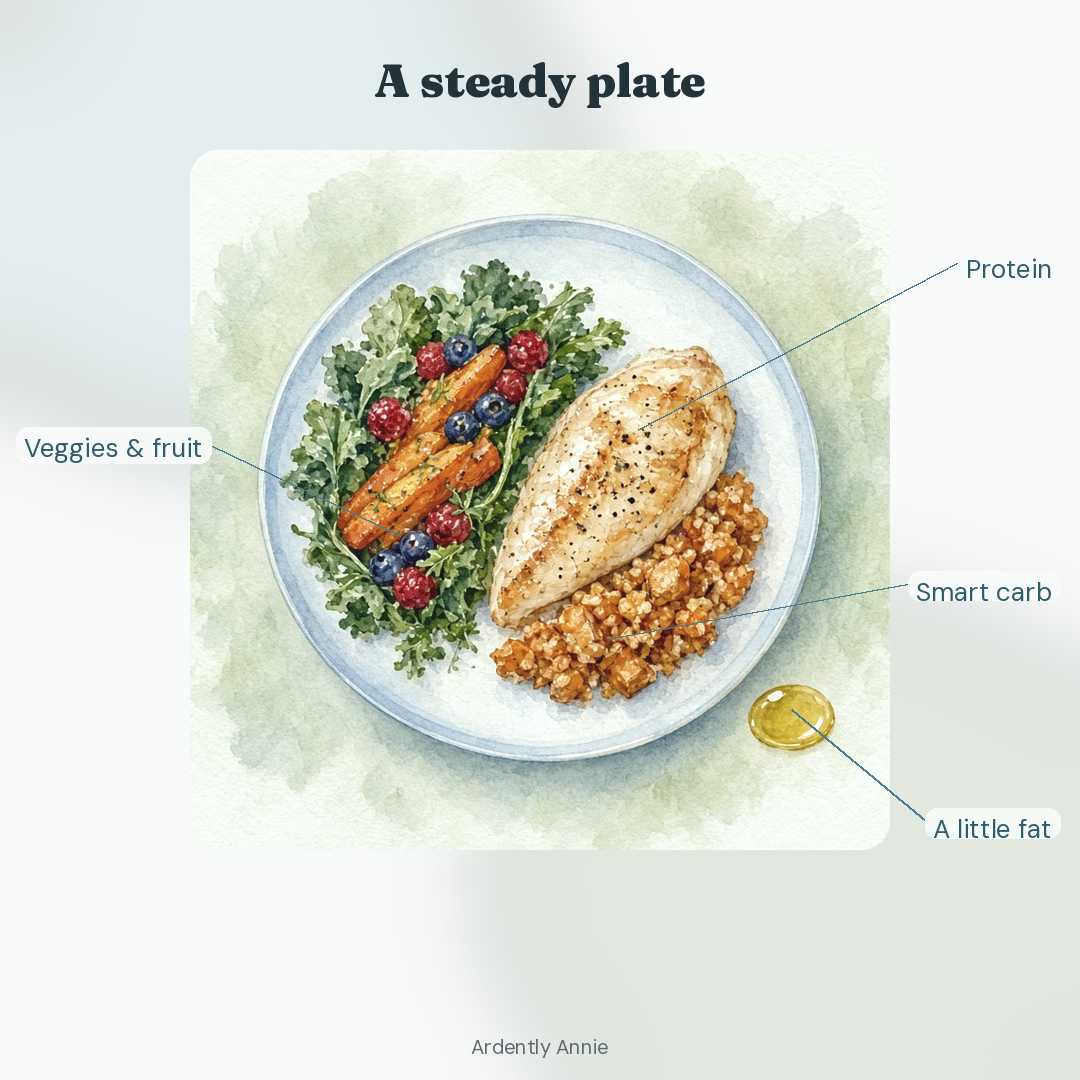
You don't need to count anything. When you build a meal, picture a plate roughly like this:
- About half: vegetables and fruit. Color and variety, raw or cooked, fresh or frozen.
- About a quarter: protein you enjoy. Eggs, fish, chicken, beans, lentils, tofu, Greek yogurt.
- About a quarter: a smart carb. Whole grains, potatoes or sweet potatoes, beans, good bread.
- Plus a little fat. Olive oil, avocado, nuts, seeds, a bit of cheese.
This roughly mirrors Harvard's Healthy Eating Plate, which I like because it focuses on the quality of your food rather than calorie math. It works for bowls, soups, and sheet pans too. It's the same "steady plate" I wrote about in Why Your Energy Crashes by 3pm.
Six small steps to begin
Pick one. Live with it for a week or two. Then add another if you'd like.
- Add before you subtract. Put one more plant on the plate you were already going to eat, like a handful of spinach in your eggs or berries on your yogurt. Adding feels generous. Restricting feels like punishment.
- Anchor each meal with protein. Skip the all-or-nothing rules and just aim for enough protein across the day. We can worry about the rest later. (More on that in Protein Without the Bro-Culture Noise.)
- Find fiber you actually like. Beans, lentils, oats, berries, pears, and whole grains all count. Most adults fall well short of the 25–35 grams a day experts suggest, so if you're starting low, go up gradually and drink some extra water.
- Cook one more meal at home this week. It doesn't need to be fancy. A sheet pan, a skillet, or a pot of soup is plenty.
- Read the ingredient list, not just the claims on the front. A short list of ingredients you recognize is a good sign. Words like "natural" or "wholesome" on the front of the box don't tell you much.
- Upgrade your snack drawer. Keep a few easy real-food options where you'll see them: nuts, fruit, cheese, hummus, hard-boiled eggs. Then the easy choice and the nourishing choice are the same one.
Easy swaps
These aren't rules, just ideas for when you're ready.
| Instead of… | Try… |
|---|---|
| Sweetened flavored yogurt | Plain Greek yogurt with fruit and a drizzle of honey |
| Granola bar on the run | A handful of nuts and a piece of fruit or homemade granola where you control all of the ingredients |
| Bottled salad dressing | Olive oil, lemon or vinegar, salt, and pepper - easy homemade dressing can also add vinegar, shallots, and dijon mustard |
| Soda or sweet tea | Sparkling water with citrus, or unsweetened iced tea |
| Chips with lunch | Crunchy veggies and hummus, or a small handful of nuts |
| White rice or pasta every night | Brown rice, farro, or half-and-half while you adjust |
| Deli lunch meat | Leftover roast chicken or a batch of hard-boiled eggs |
| Boxed mac and cheese | Whole-grain pasta with frozen peas, olive oil, and Parmesan |
A pantry and grocery starter list
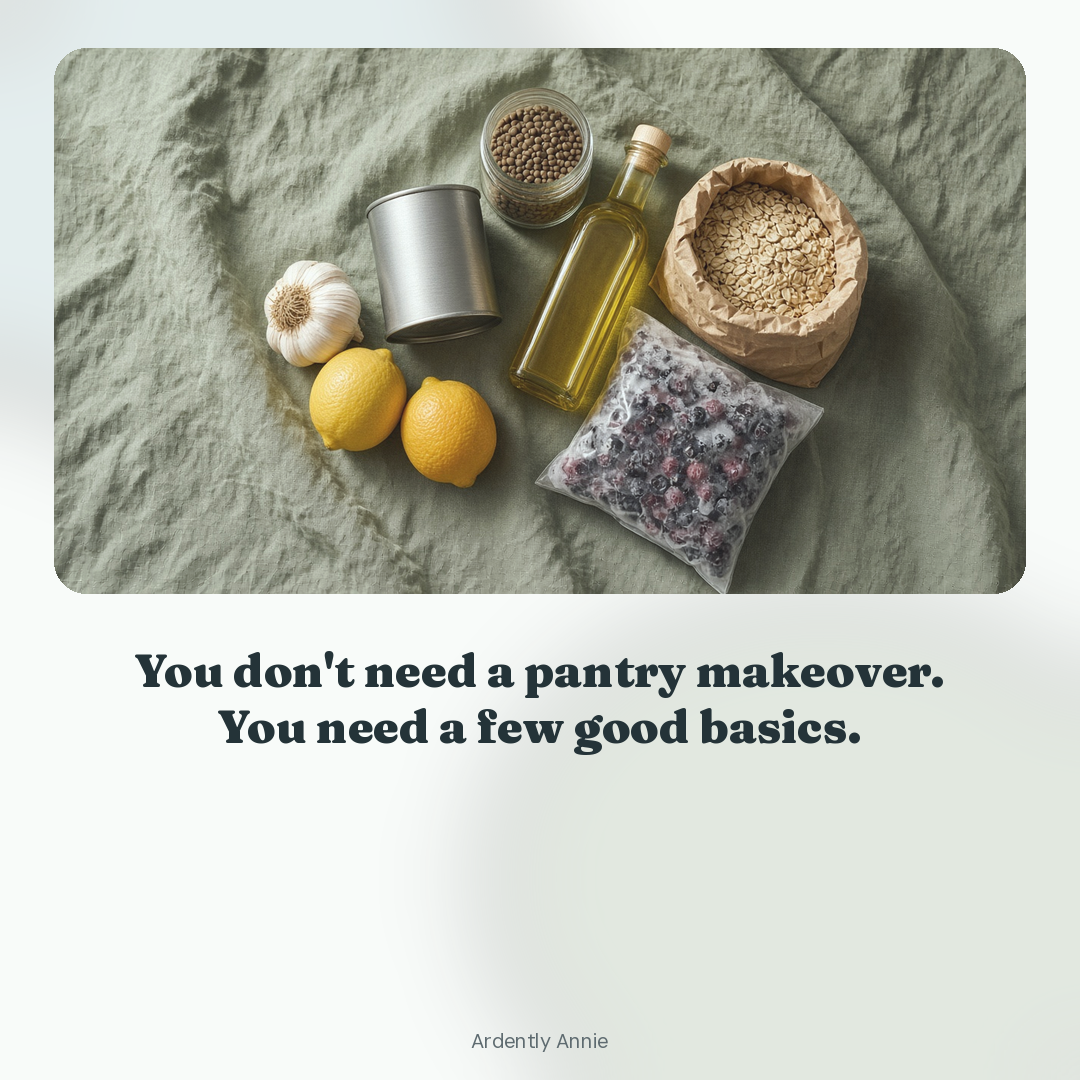
You don't have to clear out your kitchen. Just start keeping a few of these around.
- Fridge: eggs, plain Greek yogurt, a few cheeses you love, washed greens, lemons, hummus
- Freezer: berries, spinach or broccoli, salmon or shrimp, a bag of mixed veggies
- Pantry: canned beans and lentils, canned tomatoes, oats, brown rice or quinoa, canned salmon or tuna (in water), nuts and seeds, olive oil, vinegar, garlic, onions
- Flavor: sea salt, pepper, dried herbs, cumin, smoked paprika, Dijon, a good hot sauce
A sample "clean-ish" day
This is just an example, not a meal plan. Eat at the times that work for your life.
- First meal: Greek Yogurt Power Bowl with berries, walnuts, and a little honey, or two eggs scrambled with spinach on whole-grain toast or homemade sourdough.
- Next meal: A big bowl of Lentil Soup with Olive Oil Finish (made ahead on Sunday) with a piece of fruit.
- If you want a snack: Apple slices with almond or any nut butter, or cheese and a handful of almonds.
- Evening meal: Sheet-Pan Chicken & Rainbow Veg or the Salmon & Greens Skillet, eaten at the table with people you love if you can.
- And yes: a square of dark chocolate or a glass of wine if that's part of your evening. That still counts as a clean-ish day.
About budget and imperfection
On budget: Some of the most nourishing foods are also some of the cheapest. Think dried and canned beans, lentils, oats, eggs, cabbage, carrots, frozen vegetables, and frozen fruit. Frozen produce is picked ripe and holds up well, so you waste less. Organic is a personal choice, not a requirement. A conventional vegetable you actually eat beats an organic one wilting in the drawer.
On imperfection: You'll have drive-through days, birthday-cake days, and "I ate cereal standing at the counter" days. That's not failure. It's life. What matters is what you do most of the time. Lots of people find that roughly 80/20 feels right, but I'd rather you not keep score at all. Just notice what helps you feel steady, and come back to it.
Want some support?
If you'd like help figuring out what "clean-ish" looks like for your body, schedule, and season of life, the intake form is a relaxed, no-pressure way to share where you are and where you'd like to go.
Sources
- Harvard T.H. Chan School of Public Health, The Nutrition Source. "Healthy Eating Plate." https://nutritionsource.hsph.harvard.edu/healthy-eating-plate/
- Harvard T.H. Chan School of Public Health, The Nutrition Source. "Fiber." https://nutritionsource.hsph.harvard.edu/carbohydrates/fiber/
- Monteiro CA, Cannon G, Lawrence M, Costa Louzada ML, Pereira Machado P. Ultra-processed foods, diet quality, and health using the NOVA classification system. Rome: FAO; 2019. https://www.fao.org/4/ca5644en/ca5644en.pdf
- Hall KD, et al. "Ultra-Processed Diets Cause Excess Calorie Intake and Weight Gain: An Inpatient Randomized Controlled Trial of Ad Libitum Food Intake." Cell Metabolism. 2019;30(1):67–77. (NIH Clinical Center.) https://pubmed.ncbi.nlm.nih.gov/31105044/
- Lane MM, et al. "Ultra-processed food exposure and adverse health outcomes: umbrella review of epidemiological meta-analyses." BMJ. 2024;384:e077310. https://www.bmj.com/content/384/bmj-2023-077310
Annie is a National Board Certified Health & Wellness Coach (NBC-HWC) and Functional Nutrition Alliance Certified Functional Nutrition Counselor (CFNC). This guide is for general education and coaching support. It isn't medical advice and doesn't replace care from your doctor or a registered dietitian. If you have a medical condition, food allergies, a history of disordered eating, or you're on medications affected by diet, please talk with your clinician before making changes.