
We've spent two weeks on the daytime side of energy — the 3pm crash, and protein that gives your afternoon something to stand on.
This week is the part that happens with the lights off.
Here's what I'd like us to drop: the idea that sleep is a performance stat. Sleep scores, "optimize your REM," 14-step night routines. That framing turns rest into one more thing to be graded on — and it rarely helps a tired woman actually sleep.
Sleep is less a hack and more a repair shift. It's when your hormones reset their rhythm and your gut and nervous system get a chance to settle. When it's thin, everything else we've talked about gets harder.
Sleep is when you recover
Think of sleep as the shift where your body does its repair work. In one lab study, healthy young adults who went a single night without sleep built about 18% less muscle protein after a meal the next day than when they'd slept normally.1 Metabolism notices too. When researchers had women push their bedtime 1.5 hours later for six weeks, so they slept about 6.2 hours a night, their bodies became less responsive to insulin, and the effect was stronger in the women who were past menopause.2 And your immune system leans on sleep: in a study where adults were exposed to a cold virus, those who'd been sleeping under six hours a night were about four times as likely to get sick as those sleeping more than seven.3
Your mind recovers overnight, too. After a long stretch without sleep, the brain's alarm center reacts much more strongly to upsetting images, and its connection to the calmer, thinking part of the brain weakens.4 That's part of why a tired day can feel emotionally heavier. Appetite shifts in the same way: after two short nights, healthy young men had less of the hormone that signals fullness, more of the one that signals hunger, and more cravings for starchy, sweet foods.5 That's physiology, not a lack of willpower.
This matters even more in midlife. In a large study following women through the menopause transition, reports of trouble sleeping rose from about 3 in 10 women to roughly 4 in 10 during perimenopause, often as waking in the night.6 Sleep experts recommend that adults get seven or more hours on a regular basis.7 Think of that as a goal to build toward, not a grade. If you're nowhere near it right now, you're not failing. You're a good candidate for a little extra care, and for the small steps below.
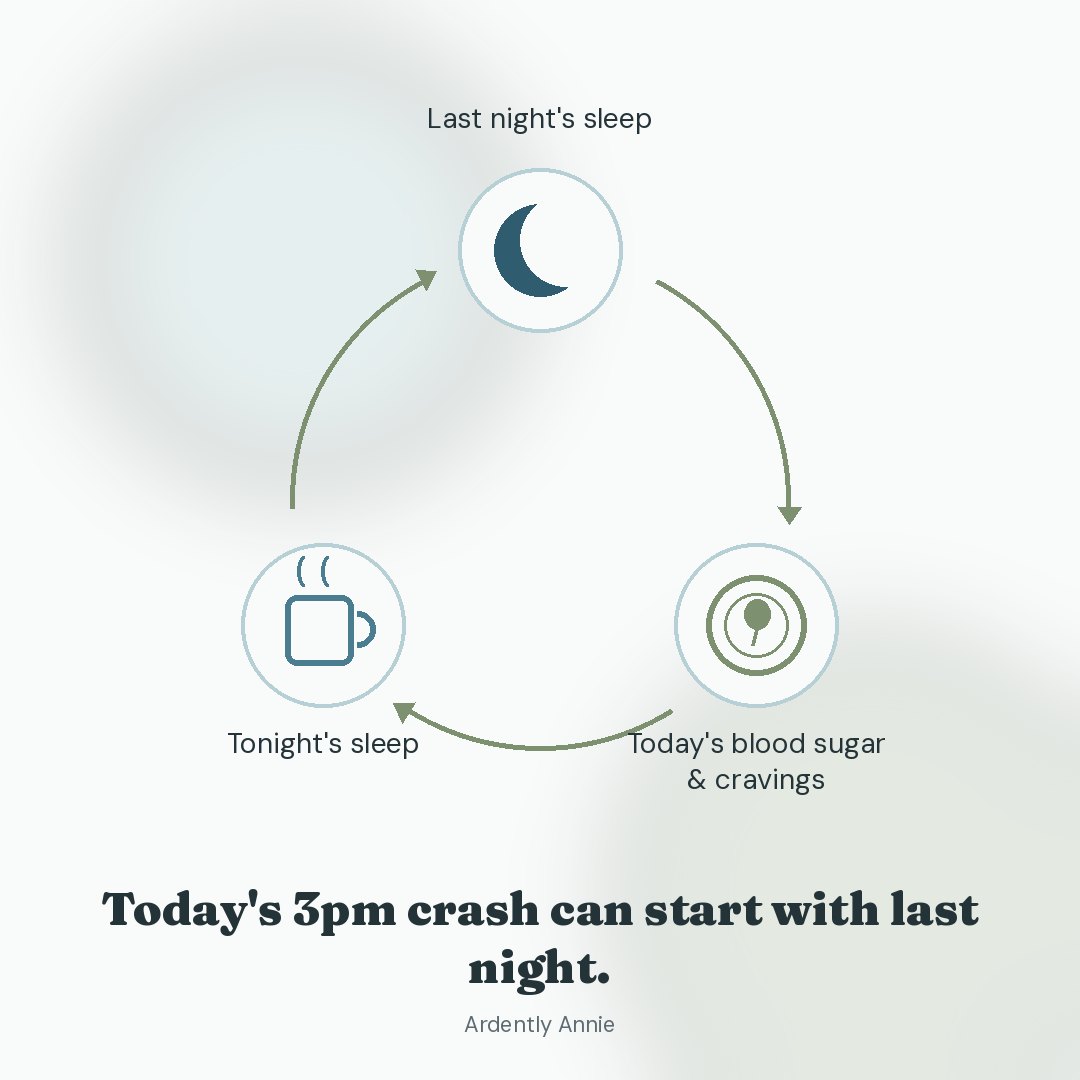
How sleep and energy talk to each other
Blood sugar. After a short or broken night, many people find blood sugar harder to keep steady the next day — and the cravings for quick sugar and extra coffee show up right on cue. Some of that 3pm crash is really last night's short sleep catching up with you. And as the study above showed, a few weeks of slightly short nights can make your body less responsive to insulin.2
Hormones. Your stress hormone, cortisol, is meant to rise in the morning and taper at night. Poor sleep can blur that rhythm, so you feel wired at 10 p.m. and dragging at 10 a.m. Appetite signals shift too, which is part of why tired days can feel snackier.
Gut. This one cuts both ways. Your gut and your sleep share a nervous system and a clock. And a large study published recently in Nature Health found that on days people ate more fiber, they tended to get a little more deep and REM sleep that same night, with a slightly calmer nighttime heart rate. Eating a wider variety of plants was linked to a calmer heart rate too.8 The effects were modest and the study was observational, so it's not a sleep cure, but it's a lovely reminder that what's on your plate at lunch and dinner is part of your bedtime routine.
Midlife. If you're in perimenopause, sleep can change in ways no wind-down routine fixes on its own: night sweats, 3 a.m. wake-ups, a brain that won't switch off. That isn't a willpower problem. It's worth a real conversation with your clinician, including about options like hormone therapy if they're right for you.
None of this is a diagnosis. It's a map for noticing your own patterns with a little more kindness.
A note on dinner (because I eat late-ish, too)
You know from last week that I eat in roughly a noon-to-eight pm window so I can have dinner with my husband. So I read the meal-timing part of that study with interest.
Days with a heavier evening meal were linked to slightly longer sleep, but also a slightly higher heart rate overnight, which may mean the sleep was a bit less restful.8 Interesting. Not alarming. And not a reason to give up the dinner table.
What I take from it: if dinner is your big, connected meal (mine is), make it a plate that helps you. Plenty of plants and fiber, protein you enjoy, and maybe not the second glass of wine or the late bowl of something sugary. Sustainable beats perfect.
Three small steps
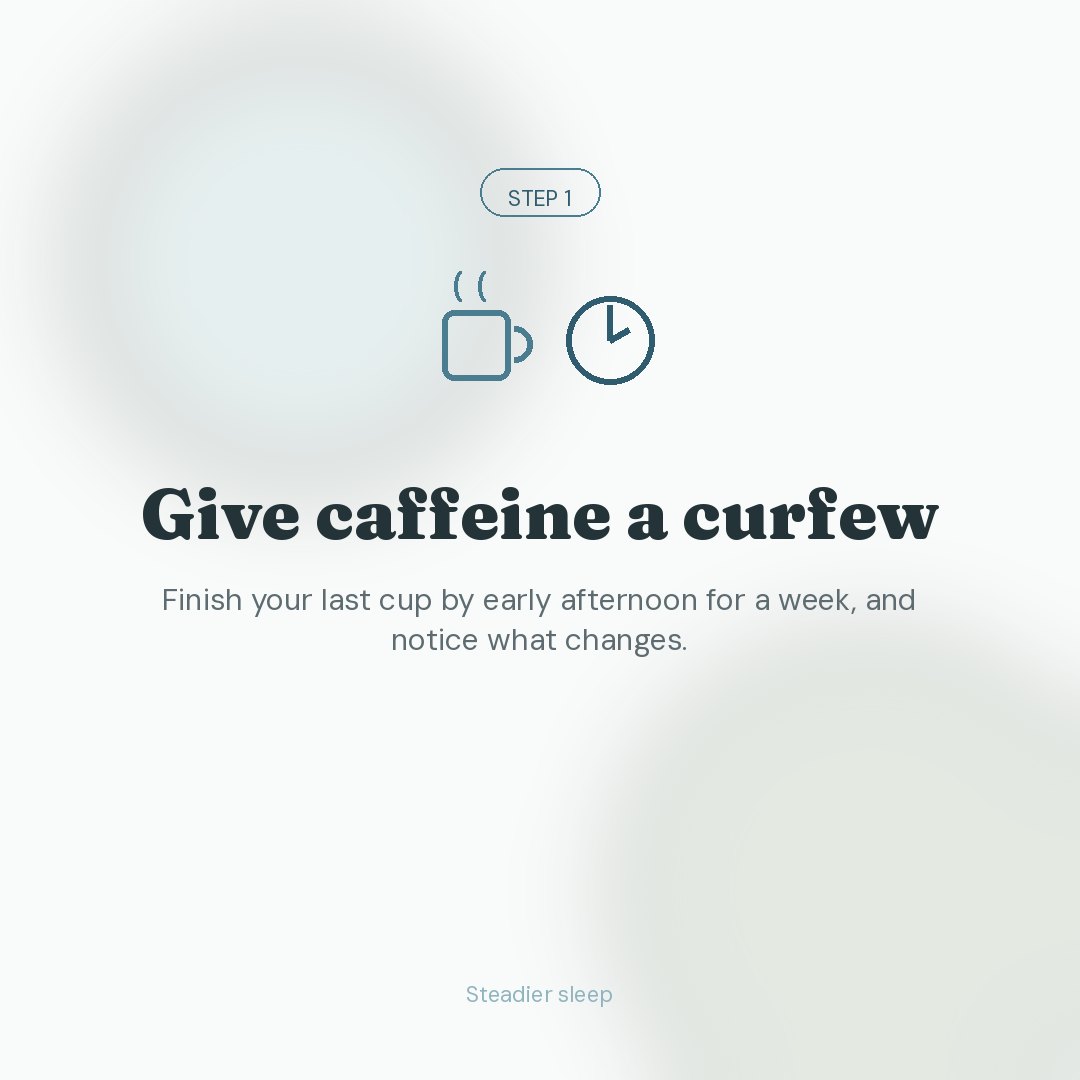
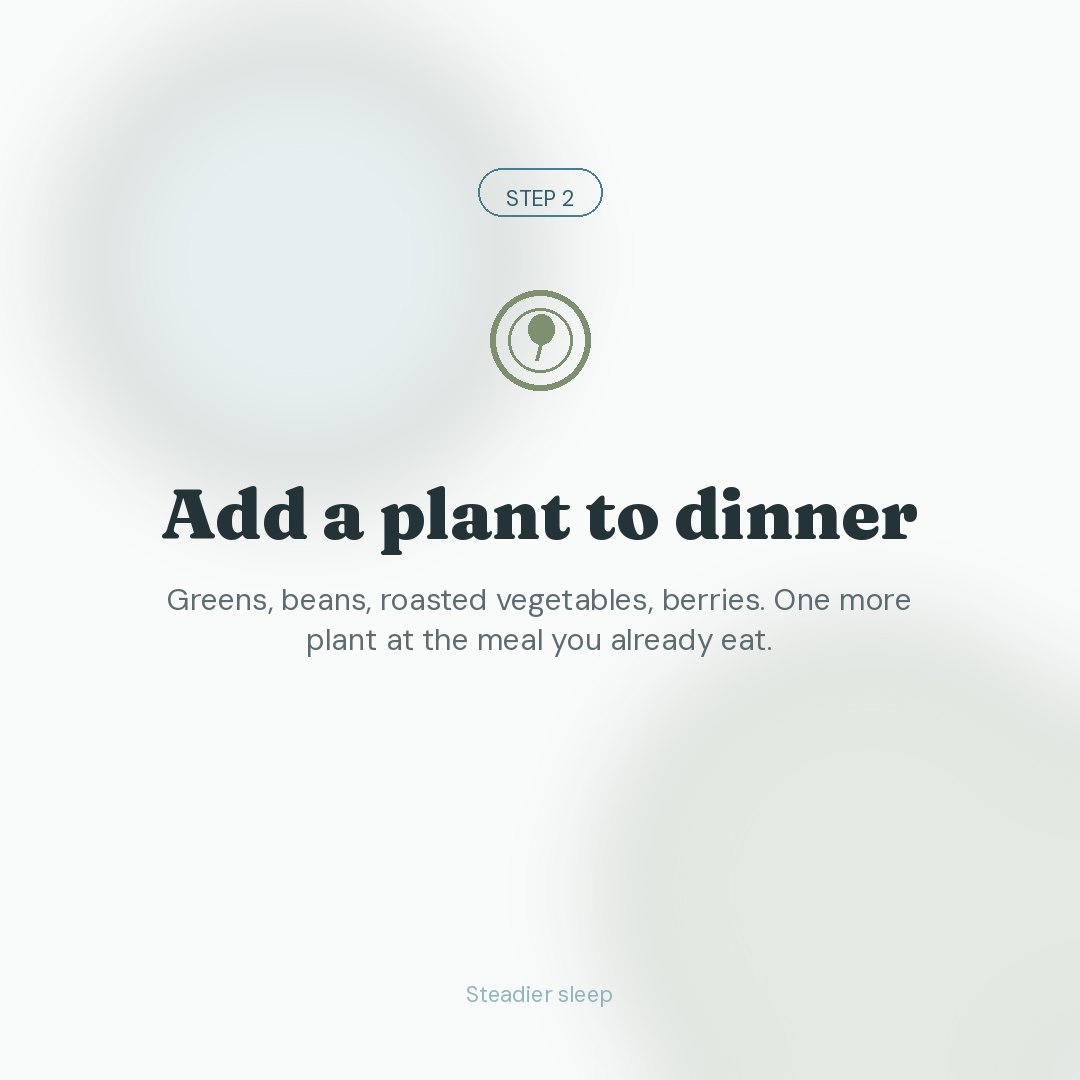
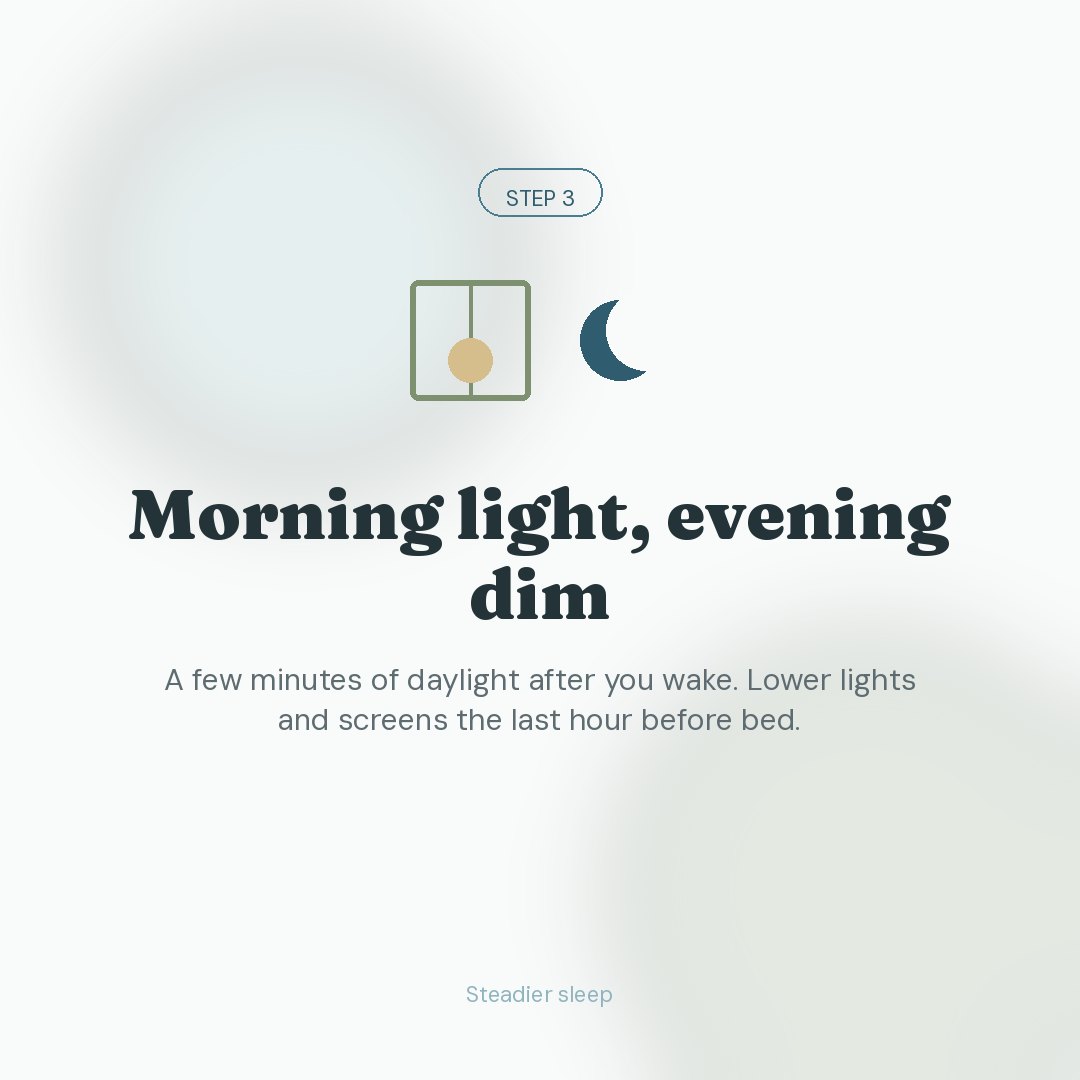
1. Give caffeine a curfew.
Caffeine can stay in your system for hours. If you're sleeping lightly, try finishing your last coffee or caffeinated tea by early afternoon for a week and notice what changes. (If the 3pm crash is why you reach for that cup, the steady-lunch and protein steps from the last two posts are your backup.)
2. Add one plant to dinner.
Not a dinner overhaul. One more plant: a handful of greens, a scoop of beans or lentils, roasted vegetables, a side of berries. More fiber and more variety, at the meal you're already eating.
3. Morning light, evening dim.
Get outside (or near a bright window) for a few minutes soon after you wake up, and lower the lights and screens in the last hour before bed. Your body clock runs on light more than on discipline.
Pick one this week. Begin where you are.
A note on magnesium (yes, I take it)
You've probably seen magnesium everywhere lately, especially magnesium glycinate. I'll be honest: I take it at bedtime myself. Here's what the research actually says. In a 2025 trial, adults with poor sleep who took magnesium bisglycinate for four weeks rated their insomnia a little better than those on a placebo. The difference was small, and it was a little bigger for people who didn't get much magnesium from food.9 The earlier studies were small and not very high quality, and newer trials, including some in perimenopause, haven't reported yet.10 So it's a helper, not a cure, and it won't outwork late caffeine or a racing mind.
The "glycinate is the best form" claim is mostly marketing. Its real perk is that it tends to be gentler on the stomach. More isn't better, either. Supplements and antacids together shouldn't go over 350 mg a day unless your provider says so. If you have kidney concerns or take certain antibiotics, osteoporosis medications, diuretics, or acid blockers, magnesium can interfere. Please ask your provider or pharmacist before you add it.11 And don't forget food: pumpkin seeds, almonds, spinach, and beans all count. I take mine because it's a small, pleasant part of my wind-down, not because the science says everyone needs it.
What I'd skip
You'll see a lot of sleep supplements marketed right now, especially to women in midlife. Most of them have even less behind them than magnesium. And if you've had trouble sleeping for weeks, the best-studied non-drug approach for insomnia isn't a gummy. It's a structured program called CBT-I (cognitive behavioral therapy for insomnia), which your clinician can point you toward.12
When to loop in a professional
If you snore loudly or wake up gasping, feel exhausted no matter how long you sleep, have night sweats or mood changes that worry you, or have struggled with sleep for more than a few weeks, talk with your clinician. Coaching supports habits and routines. It doesn't replace medical care, sleep evaluation, or treatment.
What's next on the blog
Steadier Energy path:
- Why energy crashes by 3pm
- Protein without the bro-culture noise
- This week: Sleep isn't a productivity hack (you are here)
- I Tried NMN. Here's What I Think About NAD+ Now.
- A weeknight recipe series that matches these ideas
Sources
- Lamon S, et al. The effect of acute sleep deprivation on skeletal muscle protein synthesis and the hormonal environment. Physiological Reports. 2021;9(1):e14660. https://doi.org/10.14814/phy2.14660
- Zuraikat FM, et al. Chronic insufficient sleep in women impairs insulin sensitivity independent of adiposity changes: results of a randomized trial. Diabetes Care. 2023. https://pmc.ncbi.nlm.nih.gov/articles/PMC10733650/
- Prather AA, et al. Behaviorally assessed sleep and susceptibility to the common cold. Sleep. 2015;38(9):1353. https://pmc.ncbi.nlm.nih.gov/articles/PMC4531403/
- Yoo SS, et al. The human emotional brain without sleep — a prefrontal amygdala disconnect. Current Biology. 2007. PMID 17956744. https://doi.org/10.1016/j.cub.2007.08.007
- Spiegel K, et al. Sleep curtailment in healthy young men is associated with decreased leptin levels, elevated ghrelin levels, and increased hunger and appetite. Annals of Internal Medicine. 2004. PMID 15583226. https://pubmed.ncbi.nlm.nih.gov/15583226/
- Kravitz HM, Joffe H. Sleep during the perimenopause: a SWAN story. Obstetrics and Gynecology Clinics of North America. 2011. https://pmc.ncbi.nlm.nih.gov/articles/PMC3185248/
- Watson NF, Badr MS, Belenky G, et al. Recommended amount of sleep for a healthy adult: a joint consensus statement of the American Academy of Sleep Medicine and Sleep Research Society. Journal of Clinical Sleep Medicine. 2015;11(6):591–592. https://pmc.ncbi.nlm.nih.gov/articles/PMC4434546/
- Impact of daily diet on sleep quality. Nature Health (2026). Weizmann Institute of Science / Human Phenotype Project; 4,793 person-nights of diet logs and wearable sleep recordings. https://doi.org/10.1038/s44360-026-00182-2 (Accessible summary: Anahad O'Connor, The Washington Post, Sept 24, 2026.)
- Schuster J, Cycelskij I, Lopresti A, Hahn A. Magnesium bisglycinate supplementation in healthy adults reporting poor sleep: a randomized, placebo-controlled trial. Nature and Science of Sleep. 2025;17:2027–2040. https://www.dovepress.com/magnesium-bisglycinate-supplementation-in-healthy-adults-reporting--peer-reviewed-fulltext-article-NSS
- Mah J, Pitre T. Oral magnesium supplementation for insomnia in older adults: a systematic review & meta-analysis. BMC Complementary Medicine and Therapies. 2021. https://doi.org/10.1186/s12906-021-03297-z
- National Institutes of Health, Office of Dietary Supplements. Magnesium: Fact Sheet for Health Professionals (updated January 6, 2026). https://ods.od.nih.gov/factsheets/Magnesium-HealthProfessional/
- Qaseem A, Kansagara D, Forciea MA, Cooke M, Denberg TD; Clinical Guidelines Committee of the American College of Physicians. Management of chronic insomnia disorder in adults: a clinical practice guideline from the American College of Physicians. Annals of Internal Medicine. 2016;165(2):125–133. https://doi.org/10.7326/M15-2175
Want more like this? Get the free guide.
Annie is a National Board Certified Health & Wellness Coach (NBC-HWC) and Functional Nutrition Alliance Certified Functional Nutrition Counselor (CFNC). She is not a registered dietitian or licensed nutritionist, and her coaching doesn't diagnose, treat or prescribe. This post is for education and coaching support, not medical advice. Always check with your own clinician for personal health decisions.